YouGov has come out with a fascinating survey on how left/right wing people think they are.
Inevitably they've chosen a scale where being on the right takes you up to +100 and being a lefty is -100 but, despite this outrageous bias I think there's something quite valuable about asking people upfront where they see themselves on the political spectrum. So the headline news is that 25% of people see themselves as left of centre and 24% see themselves as right of centre. Hurray! We're winning, let's move on...
Although another way of saying that would be that the majority of people do not describe themselves as left or right-wing, even a bit.
The other number that jumps out at you is that women are twice as likely to be less certain of their political direction. Seeing as most men think they know everything I guess this fits.
Women were 22% left of centre, 16% right of centre while with men with have 29% left of centre and 30% leaning to the right with 22% for both seeing themselves as in the centre. So a 'political' woman is much more likely to see themselves as on the left or the centre than on the right, while men are less likely to take the middle-road, which is possibly connected to that idea that men tend to be much more certain of their correctness and therefore often take a more extreme view.
Possibly.
Although having said all that the big thing for me is that so many people simply did not know how to answer the question which, as ever, is probably for a whole number of reasons. Come on, let's look at the regions (and Scotland, which is not a region but a country). Would it shock you to find out that Scotland and the North were the most left wing parts of the UK? No? Me neither.
There is an interesting difference between them though in that Scotland's 33% left, 23% centre and 15% right is not identical to the North's 31% left, 19% centre and 20% right. The North's lefties are more likely to see themselves as harder left but, unlike in the North, Scots are more than twice as likely to see themselves as on the left than the right.
While London is to the left of the sea of right wing South surrounding it, it is still the place where a 'person' is most likely to describe themselves as on the far right. I bet loads of that is Essex.
I should point out that 2% of the South thought David Cameron was very left wing. Who'd have thought? I guess you can show anything with statistics...
Monday, January 31, 2011
How left wing are we?
Monday Misc
So there's revolutions sweeping the Arab world, often in places where the space for building up a progressive political alternative has been very limited. Indeed that's one of the reasons those revolts are happening. It's exciting, worrying, confusing and exhilarating by turns, but there's one thing I do know - I haven't a clue where it's all going to lead.
- It turns out the public do believe in climate change. Guardian.
- The right wingers against the cuts. Hangbitch.
- Why the Green Investment Bank has been another gimmick. Liberal Conspiracy.
- Christian Aid attack homophobia in Uganda. Good on them. Pambazuka.
- UK Uncut, a failure in civil policing. Dawn Foster.
- Neoliberals, privatisation and magic. Practically Insurgent.
Activist dies in fire
I was very concerned to see that after a fire at a protest camp in Midlothian a young man has died and a woman is seriously ill in hospital. The death is not being treated as suspicious.
The Bilston Glen camp is probably one of the last surviving road protest camps existing in the country. The camp issued this short statement;
"The people of Bilston Road protest site regret the loss of one of their friends, who has been a valued member of our community, and extend our deepest sorrow to his family and friends, who we would like to get in touch with as we have no way of contacting them. We would ask everyone to respect our grief."
My condolences to the protesters and family members of those concerned.
Sunday, January 30, 2011
Sunday Misc
Apologies for the short absence - it's been a busy week.
- The Guardian are talking to the wonderful Arundhati Roy.
- Bright Green looks at the council cuts and alternatives to austerity.
- Liberal Conspiracy look at climate and weather.
- Harpy Marx compares and contrasts the Ed Balls of yesterday and today.
- Red Pepper ask us to be careful what we vote for.
- Splintered Sunrise takes a look at the big society.
Wednesday, January 26, 2011
London Mayoral Selection: Farid Bakht
I first met Farid a fair few years ago and he's always struck me as a level-headed, principled Green. Likable, thoughtful and engaging he's a talented and strong minded left-winger, without some of the bile or dogma that you sometime find on the left.
Anyway, I was delighted when I heard he was standing for selection to be London's Green Mayoral candidate. So far that means we have two excellent choices before us with Farid and Jenny. I wonder if we'll get any more? Here Farid talks about his vision for London. The next Mayoral candidate must offer Londoners an inspiring vision for the capital. We can do this in London the way our leader did in Brighton – by offering a radical, coherent alternative to the three main parties.
We must be part of the anti-cuts movement. Many Londoners will be hit particularly hard by coalition policies - young people and students, women, and people from ethnic minorities.
Investment in free education and affordable public transport are vital for this city’s development and as candidate I would defend both.
Bringing back the Congestion Charge to the Western Extension Zone is one way we can reverse the recent fare rises.
First-time buyers are priced out of the market. Meanwhile, one in ten households are stuck on housing waiting lists.
We have to pressure local authorities to use their powers to bring empty homes back into use.
We have to set out a programme to refit homes to reduce carbon emissions, reduce heating bills and reduce unemployment.
With 15 years experience running small businesses, I want to take our message to this vital sector, talk their language and explain why our party is their natural choice.
I was recently an International Coordinator for the Party, serving on the National Executive. I am a communicator on behalf of the party at rallies, meetings and in the media.
I am currently leading a working group on ethnic minorities. We can no longer ignore the one in three Londoners who are of foreign origin.
I stood as Parliamentary candidate in Tower Hamlets and took the party into communities where we had been largely absent. This was done via ethnic TV, radio, newspapers, social media, stalls, meetings, networking and door-to-door conversations
We must engage with ethnic minorities who find our beliefs, ideas and policies are most in line with them – if only we would talk to them.
This is the strategic objective we must set ourselves.
By recruiting more ethnic minorities we will boost our electoral chances.
The Greens must reflect the city in gender, ethnicity and sexuality if its people are going to vote for us.
Regularly voting Green, I joined the Party after spending a few years in Bangladesh. There, I saw the devastating impact of floods and climate change and its connection to poverty and social injustice. I campaigned against India and China's mega-dam building projects, for the economic rights of female garments workers and for rickshaw pullers. I set up a Renewable Energy Association to promote solar power, a sector which has now taken off.
On my return, I joined the Green Party because for me it is the only one which has a coherent ideology to transform society in both rich and poor countries, for men & women, for young & the elderly.
Half-Basque, half-Bengali, born in Hackney, I was brought up in London. Married, I have a 9 year old daughter & live in West London.
Tuesday, January 25, 2011
Sex Workers' and self organisation
In this next installment of the ABC of feminism we have a guest post from Jane Watkinson who takes a look at some of the history of how sex workers have collectively organised to protect their rights.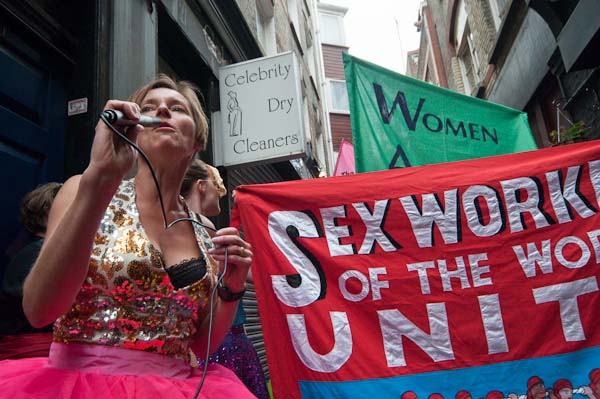 The sex workers’ movement really took off in the 1970s as sex workers’ within Lyon, France occupied churches in protest against police corruption and treatment against sex workers. The direct action received international coverage, propelled the French Collective of Prostitutes and the English Collective of Prostitutes to form, as well as assisting with the development of many other sex workers’ organisations and collectives around the world.
Whilst sex workers’ organisation has existed for many years, the ‘prostitutes’ right movement’ came into its own in the 1970s; as the fight for sex workers’ rights to be considered with respect and seriousness became more prominent. The 1980s AIDS’ crisis was a double edged sword, as governments provided sex workers and health officials money to help sex workers gain access to preventative treatment and services such as condoms – but it also came with a reinforcement of the negative stigma associated with sex work through legitimising the view that sex workers are the ones who require mandatory testing and health surveillance, not the clients (most likely male).
Furthermore, AIDS funding for sex workers’ organisations has often been associated with an ‘exiting’ strategy. The USA only now provide funding for these organisations on the condition that they advocate for sex workers to exit the industry. This puts a strain on resources, especially given the legal situations of countries such as France where the possession of condoms can be attributed as evidence for ‘passive soliciting’. ‘Passive soliciting’ was introduced in the Domestic Security Bill in 2003 by Sarkozy and has been seen as a human rights attack, as the police often arrest sex workers based on their attitude or dress (even though dress was removed from the legal text after an amendment).
Nevertheless, not all community health organisations have suffered from these conditions. In France, the community health organisations posed in direct conflict with the social workers who took an abolitionist line. Furthermore, in Sonagachi, Kolkata, the sex workers’ AIDS organisation has over 60,000 members, with the Durbah Mahila Samanwaya Committee that runs the project even setting up a civic bank for the sex workers.
Gregory Gall documents sex workers’ organisation. He refers to the development and sophisticated progression of the movement, as the collectives and heath organisations were later complemented by the formation of trade unions for/by sex workers. Whilst Gall refers to the disappointment of sex workers’ unionisation across the world, he states that there have been relative success stories such as in the USA where Lusty Lady’s was unionised and turned into a sex workers’ cooperative. Within the UK, we have the International Union of Sex Workers; however, whilst the union has had relative success affiliated to the GMB specifically in the context of assisting lap dancers rights, it has various controversies surrounding their membership criterion that supposedly allows related groups such as pimps to join. Furthermore, there are concessions that their level of organisation has been limited – reasons for this however are hardly uncommon in regards to the sex workers’ movement at large.
There are problems with sex workers feeling ashamed because of the strong stigma attached to their work meaning they often feel unable to show their faces at protests, covering them up with masks. The laws surrounding sex work do not help with this; our own laws in the UK are a testament to this. Whilst it is legal to have commercial sexual services, there are numerous laws surrounding the industry that make it very dangerous for the sex workers involved to work. This is largely shaped by a ‘moral’ concern for keeping the ‘public’ areas ‘safe’; in consequence sex workers are given ASBOs, pushed into dark unsafe areas and prohibited to work together outside or indoors.
Internationally there are largely calls for decriminalisation of sex work where sex work would be recognised as legitimate work to be considered under existing work laws. There is a strong movements in countries such as France against state legislated brothels, especially given France’s history re brothels and the mandatory health tests that undermine sex workers’ movement and freedom. Regardless, some sex workers’ want brothels, others want designated areas so they can work on the street (managed zones, as designed by Liverpool and as ignored by the Labour government); illustrating the diversity amongst sex workers and the need to provide them space to air their views and arguments in public.
Labour were central to moving the UK closer to a prohibitionist stance. Nevertheless, there are countries such as New Zealand who have adopted a decriminalisation position (influenced by sex workers’ organisation). However, the UK have taken their influence from Sweden and its prohibitionist legal context, as women are treated as vulnerable ‘victims’ said to be in a false consciousness unaware of their experienced ‘coercion’. Sex workers’ organisation is often isolated from the feminist movement as it is polarised by these debates surrounding choice and coercion. Regardless, most feminists and researchers into sex work come to the sensible conclusion that sex workers’ are neither forced or freely choosing sex work – there is a complex mixture of both.
Whilst the sex workers’ movement has come a long way since the Lyon sex workers’ strikes, there are still many obstacles for sex workers to be given the rightful legal, cultural, social and economic recognition they deserve. There are strong moralist forces within countries such as France and the UK that dictate their policies around sex work, making it harder for sex workers to make a living.
However, sex workers’ organisation has illustrated profound resilience. The movement has developed in sophistication and whilst unionisation may not have been as successful as hoped with many unions rejecting sex work as ‘work’; there are real building blocks that sex workers can hold on to and work in correspondence to progressive forces to counteract the negative and moralistic constructions of sex workers that undermine their rights to public space and consideration.
Monday, January 24, 2011
Kate Belgrave: Women and the cuts
Continuing my series on the ABC of feminism guest posts we have this fantastic piece from Kate Belgrave who has been interviewing women up and down the country about the impact of the cuts in their area.
There are times when I wonder if being an old woman without money will be as funny as all that. It seems likely that I'll find out first-hand in the near-ish future.
Right now, I get to watch.
I'm in a room in Gateshead with about 15 older women at a Personal Growth - Take Individual Steps session (known as PG Tips here at the Tyneside women's health centre). I wouldn't describe the group, or the session, as a touchy-feely waste of public money and focus, although I
imagine George Osborne would without looking round the door. Older and sick people aren't above criticism or suspicion in these censorious times, and hell – what would I know? Perhaps George is some kind of life-science genius. Perhaps it's unfair to give a group of unwell old girls like this a free pass for sharing a pot of tea together when they could be out on all fours in the snow cleaning something. It's not like anybody else gets to enjoy life.
These women are getting on in years, though. Two or three of them are about 40. The rest are in their 50s and 60s. Faces are lined, bodies are soft, and hair is thinning and grey.
I'm sitting with them, because I wanted to talk to Newcastle women who were likely to be affected by the coalition government's cuts. I've done well on that front, if I can put it that way. A lot of the women in this room collect incapacity benefit – a means of drawing income which the Murdoch stable would have us believe is leapfrogging politics, pimping and web paedophilia to top the list of pestilent ways to source a buck. Not that these women will be sourcing income
through incapacity for long. Their days of drawing incapacity (and perhaps any) benefit are numbered. Incapacity is being phased out, along with any notion of genuine need. Everyone who collects incapacity is being assessed for fitness for work. They're being moved to the smaller job seekers' allowance, or to the employment support allowance if they're deemed to need support to work. Some will be found ineligible for support altogether.
Nobody I've spoken to likes their chances. I've even met rightwingers who are worried about assessment. Only ten days ago, I interviewed a physically disabled woman called Mel Richards who felt that the coalition (which she generally supported) was wilfully failing to recognise people she referred to as “deserving poor.” She insisted that her good work record and national insurance contributions entitled her to support when illness struck (and was technically correct – incapacity benefit recipients must generally have paid national insurance).
She'd run a campaign called “I'm Right – but cuts are wrong.” “I still believe there is such a thing as entitlement. I paid, so I was entitled. The government is not acknowledging that.”
Most of the women in this Gateshead room worked, and paid tax and national insurance, for years – 30 years at the HMRC in one case, 20 and more years at BHS in another – before age and ill-health queered the pitch, as they do. Some say they were eased, or bullied, out of jobs and/or better places in the work hierarchy and that their problems with depression set in around then. Depression sets in for me just talking about it. I've been in the workplace long enough to know how women are rated once they've past the age of sexual attractiveness
and use. Miriam O'Reilly is, alas, not the only one. She's one of the better looking.
I wonder, too, about the likelihood of employers giving these already-discarded older women a chance.
Let's take Diana Shearer, who is 51. Her last job was in IT. She was there for about 14 years. She is incontinent and suffers from severe depression: the two problems aren't unrelated. She is furious about the pressure she's under as she waits for reassessment. “Every time there's something comes through the post, I'm wondering is it going to be that letter? It's every day for me [at the moment]. How dare these people stop my benefit? Who going to decide?”
Chris Swales is probably in her 50s, but her seamed face and thick glasses make her look elderly. She worked for 30 years the public sector before she was retired for ill health. “I got a letter and a medical assessment [when I was retired] so I rang Incapacity (the DWP) and told them that I had been ill-health retired. I still had to go for a medical (she had her assessment last week, although she struggles to recall it - the other women in the room have to remind her when I ask). I'm just concerned that I'll get a letter saying that I'm not entitled to it.”
It seems highly unlikely that employers will pick these two from Newcastle's large crop of jobless. Newcastle council is due to jettison 2000 people. There will be long queues for jobs, and old, shaky women will be at the back of them. I've worked all my life, but have never made the kind of money you need for complete security today. I look at these women and see me.
NB Names of women at the Gateshead Centre have been changed – they were concerned that publicity might affect their benefit assessments. I'll upload the audio from these interviews to my site when I get back to London next week.
Saturday, January 22, 2011
Saturday selector
- Like designing posters? Try the New Home Front poster competition.
- Those celebrating the rise of Balls should do well to note that he is already denouncing his previous economic doctrine. In other Balls news Richard Osley notes the oh so hilarious practical joke Blair played on him once.
- Luke provides his usual service letting us know council by-election results. The Lib Dem figures are utterly shocking.
- Prisoner Ben writes on prisoner voting.
- Left Foot Forward asks how we can take the green message into the mainstream.
- Tom Chance writes on Green Party policy making. Some bloggers just live a party life-style!
Friday, January 21, 2011
Bjørn Lomborg speaks: but is he right?
People seemed lukewarm about the Ten O'Clock Show last night but I thought it was good. It might not have been as funny as the mythical Daily Show but it was certainly as strong as the actual Daily Show that's on daily, and their guests were far better than some of the odd choices Jon Stewart finds himself opposite of. For example Bjørn Lomborg isn't someone you see much on the telly and it's always nice to see an enthusiast for their subject given free rein.
Mr Lomburg does have a little bit of a chequered history when it comes to green issues though and is brought to you by such controversies as opposing the Kyoto agreement but he recently recanted and we're all friends again.
So the interview he gave, with Jimmy Carr of all people, ranged from interesting to energetic to slightly bonkers, which is all to the good. However his solutions did leave a little to be desired in my view.
For example making clouds whiter and setting off (artificial) volcanos sounds brilliant in a sci-fi movie but there is a problem with thinking that the problems caused by pollution can be offset by loads more pollution.
I personally think that in the US painting roofs white is worth doing because it cools the buildings in hot countries and means the air conditioning does not have to work as hard cutting energy use - but whether there's a point in changing the planet's albedo (the colour of the surface of the globe), well, I'm yet to be convinced.
There's a real danger in Lomburg's position in that if all our efforts are devoted to finding technological devices to allow us to carry on doing what we're doing we don't question how we're contributing to the problem.
Now, in the interview Lomburg says we keep promising to cut emisions but we don't - so let's stop promising to cut emisions and get on with coping with the mess we're making. I can't help feeling he's under-estimating some of the problems climate chaos will and is causing and over-estimating the capacity of super-duper technologies to magically solve the laws of physics.
Not that I'm against useful technologies or substantial investment in renewable energies, as Lomborg also suggests. However, this cannot be a substitute for the real social change we need in order to stop causing the problem in the first place.
Thursday, January 20, 2011
Today's selection
Here are some of the known knowns we are having to contend with right now;
- A new edition of the Carnival of Socialism is out at Bob from Brockley. A fine, fine job.
- Scottish Newsnight takes a look at the Green pitch to the electorate.
- Claude takes David Laws down a notch or two.
- Andy at Socialist Unity has some wise words about the way celebrity culture is distorting culture "One of the worst aspects of the cult of celebrity in our pop culture... is the idea that singing is an elite activity. In fact, singing, and especially collective singing is a fundamental and emotionally satisfying form of social bonding in all human societies; and while the genius of the most gifted singers should be celebrated, this should not be at the expense of discouraging others from participation."
- The Third Estate ask why it's ok for some clubs to exclude women.
- Ellie May talks about whether feminism has to be opposed to porn.
Wednesday, January 19, 2011
This is what democracy looks like?


What a joke. It doesn't have to be this way. Last year Caroline Lucas put forward some ideas for modernising the processes of Parliament that would do away with all the pantomime so politicians could spend time on actual politics rather than ceremony and pointless rituals.
What on Earth has a bunch of unelected plutocrats burbling on about anything that comes into their heads got to do with democracy?
Let's replace this bunch with a modern, elected house that gives representation to every current of ideas in proportion to the number of people who vote for it.
Tuesday, January 18, 2011
South Korea disease outbreak
I've not seen this reported in the English press at all. You have to go to Cattle News (!) to find out that there is a massive animal disease outbreak in South Korea, and they are only reporting it because of the impact it's having on US markets. As things stand 16% of the entire pig and cow herds have been slaughtered (2.1 million animals). Obviously the markets think this is great because it has seen a jump in the future's markets. “The movement of animals is completely paralyzed,” said Dennis Smith, a senior account executive at Archer Financial Services Inc. in Chicago. “They basically are not producing any meat for their retail counters. They’re going to have to come to other people, primarily us.”
At the same time they are suffering a bird flu outbreak. Considering how much the press used to go wild over bird flu stories the fact this is passing them by seems perverse. The bird flu immediately prompted the authorities to cull half a million birds and we will have to see if this has contained the outbreak.
The Wall Street Journal blog reports that "people involved in the months-long containing operation are reported to be suffering from psychological damage. The National Emergency Management Agency said in a statement today it started a program to support approximately 6,500 people involved, including farmers, vaccinating and culling officials, with a psychological program."
In addition to this the outbreak may have spread to North Korea and they are currently suffering their coldest winter for some time. Not good news, but it is, I think, news which has been almost entirely ignored in the British press.
David Davis champion of liberty!
There was a time when David Davis was held up as a champion of civil liberties and cuddly Toryism, who knows why. The claim was he was in the pocket of Liberty and he stood in a long line of Tory civil libertarians. I wonder how strong that claim is looking today? David Davis has teamed up with Jack Straw to oppose the government giving voting rights to a limited number of prisoners. Now, we know former Labour Home Secretary Jack Straw has no truck with Human Rights, he eats them for breakfast no less, but what is Mr Davis upto?
Well he's found a way of opposing Europe and these namby pamby rights things simultaneously - for which I'm sure his leader Mr Cameron is eternally grateful.
Davis said "There are two main issues here. First is whether or not it is moral or even decent to give the vote to rapists, violent offenders or sex offenders. The second is whether it is proper for the European court to overrule a Parliament."
On the second point first, the European Court of Human Rights has, not for the first time, expressed concerns about the behaviour of the UK government suggesting that the decision it took in the nineteenth century to deny prisoners the vote was wrong. We should listen to them.
However, how can it be right to "give" people the vote when they've behaved despicably? Well my view is we don't don't give people the right to vote, it's a right. We take it away from people in an act designed to 'other' them as outcasts with no say in society even as we should be trying to rehabilitate them and convince them they do have a stake in society.
Human rights are, or should be, universal. They don't apply to 'nice people' only, otherwise we wouldn't actually need them. It's precisely the demonised in society that are most in need of protection from the excesses of political fashion. Update
Monday, January 17, 2011
My five favourite Martin Luther King Quotes
"It may be true that the law cannot make a man love me, but it can keep him from lynching me, and I think that's pretty important."
"A riot is, at bottom, the language of the unheard."
"Human salvation lies in the hands of the creatively maladjusted."
"I refuse to accept the view that mankind is so tragically bound to the starless midnight of racism and war that the bright daybreak of peace and brotherhood can never become a reality."
"Our scientific power has outrun our spiritual power. We have guided missiles and misguided men."
Sunday, January 16, 2011
Good news
Let's have some good news, it wasn't easy finding six;
- Syrian refugee wins his battle to stay in Scotland.
- Tunisia: the overthrow of a dictator. Also at Lenin, AVPS, Bright Green, Doc Richard
- Tel Aviv sees mass demonstration for human rights.
- Suffragette Jujitsu - what's not to like? Loved this post.
- Davos imposes gender quotas on companies. Interesting.
- You don't have to just eat vegetables. You can make famous pictures from them too via here.
Church gives women marching orders
A church in Sydney has given the organisers of the annual International Woman's Day an early Christmas present in the run up to the fortieth anniversary of the Sydney event. They've banned them from their traditional starting point. It's a timely reminder on the one hundredth anniversary of International Women's Day itself that we do not yet live in utopia.
According to the Sydney Morning Herald Anne Barber, one of the organisers said ''It's a traditional meeting point and somehow the church has right of veto.'' It's quite understandable that after forty years for the church to suddenly tell these marches to bugger off has created friction.
Another organiser, Gabe Kavanagh, was shocked. ''The rally has been held there for decades,'' she said. ''There's never been a problem with rubbish or noise.''
It's quite bizarre that this event is being banned when the square is the location of the Town Hall, a natural point for any public demonstration to focus on, and one that should not have to have to say so of the church to go ahead.
However, I'm going to make a prediction - while last year's event was on the smallish size this year will see a bumper turnout of women all determined to tell the church where they can get off.
NB People might remember the last time I spoke about the church in Sydney when the archbishop there advised against voters turning out for the Green Party who were "sweet camouflaged poison". I don't think we've heard the last of them somehow.
Judy Finnigan talks sense on crime
I picked up a Daily Express on the train yesterday fully expecting it to give me some ammunition for a bile filled rant about thier homophobia, racism or just plain sillyness - but no - I come to praise the Express not to bury it, because when I turned to Judy Finnigan's column on the school boy who's been sent down for throwing a fire extinguisher it was surprisingly sensible.
Judy focuses on the fact that eighteen year old Edward Woolard was persuaded to hand himself in to the police by his mother, who escorted him to the police station. It took real guts for the pair of them to do this and I doubt the praise from the judge made either of them feel any better about that decision when the heavy handed sentence of 32 months was handed down.
Here's some of what Judy said next;
AS I watched Tania Garwood push through the scrum of waiting press photographers, clasping the hand of her teenage son as she led him into court, I saw a determined and courageous mother convinced she was doing the right thing for her boy.Well done the Express for printing this.
I doubt she thinks that now... Poor Tania. For what I am sure she thought would be a short, sharp slap for her son – maybe a few weeks in prison, or a community service order – has turned into a nightmare for both Edward and her. She broke down and sobbed inconsolably when Justice Geoffrey Rivlin QC delivered his harsh sentence.
I’m not surprised at her shock. Because she may well have just ruined her son’s future. Young offenders institutions are bleak, tough places, full of young men in mental torment who will make Edward’s life hell...
And yes of course the judge was right to punish him. But this punishment is far too harsh. It does not fit the crime.
And while Tania Garwood now probably deeply regrets taking her son to the police station mothers everywhere must be shuddering with horror, vowing that if their child does something reprehensible, stupid and illegal they will remain silent.
So while the judge has punished Edward he has also punished Tania, whose courage he praised in court.
And by making such an extreme example of Edward (whose sentence, I am certain, will not prevent any other young protester from momentarily losing his head) Justice Rivlin has probably ensured that other mothers who want to “do the right thing” when their kids have done wrong will certainly pause before handing them over to what they fondly believe is a fair justice system resulting in a fair, appropriate punishment.
I think she has made a strong point worth considering here. By making an example of this young man many will take from it the lesson, not that they should not break the law, but that the law is unjust and it is not in their interests to cooperate with it, even when they think they should.
Friday, January 14, 2011
Oldham East and Saddleworth result
It was no surprise that Labour won, although I have to admit the fact that the Lib Dems managed to slightly increase their vote share was unexpected. Of course this was aided by the Tory strategy aimed at bolstering the coalition by fighting a low key campaign where they might, arguably have been able to fight their way into second place. However, it's useful to note that the Lib Dems are still able to mobilise a viable, if losing, campaign.
The results taken from wikipedia show Labour's current increased poll ratings being borne out on the ground.
| Debbie Abrahams | Labour | 14,718 | 42.1% | +10.2 | |
| Elwyn Watkins | Liberal Democrat | 11,160 | 31.9% | +0.3 | |
| Kashif Ali | Conservative | 4,481 | 12.8% | -13.6 | |
| Paul Nuttall | UKIP | 2,029 | 5.8% | +1.9 | |
| Derek Adams | BNP | 1,560 | 4.5% | -1.2 | |
| Peter Allen | Green | 530 | 1.5% | N/A | |
| Nick "The Flying Brick" Delves | Monster Raving Loony | 145 | 0.4% | N/A | |
| Stephen Morris | English Democrats | 144 | 0.4% | N/A | |
| Loz Kaye | Pirate | 96 | 0.3% | N/A | |
| David Bishop | Bus-Pass Elvis | 67 | 0.1% | N/A |
In other news I was pleased that the BNP failed to either get their deposit back or achieve their previous fourth place in an area they think of as a target. I also happen to think that Peter Allen's 530 votes were very good considering the Greens had not stood in the area before.
I'm never sure about standing candidates in these kind of elections where we're unlikely to come fourth or better. It seems to be a prime opportunity to risk coming below Bus-Pass Elvis without any likely returns. I do wonder whether taking the lost £500 deposit and instead spending it on any random area in the country in a membership recruitment drive would actually have a better longer term impact.
I'm glad Peter got a good result as I would have been worried about mentioning this if he'd got less than 1% but it's hard enough for the Greens standing in by-elections where we have a good electoral history and a strong local party - but here this was the first time we'd ever stood, so it was a real gamble.
It reminds me of when the Greens stood against David Davis in his vanity resignation/restanding during the last Parliament. Ultimately we came second, which was a relief, because if we'd been beaten by the English Democrats et al it would have been a real embarrassment. I'm unconvinced we gained very much by putting ourselves in the firing line on that occasion.
If we're going to stand in these things it would be handy to get more of a by-election machine going, in the way the Lib Dems do - so we're prepared to give local parties support when they fight by-elections like this. But I do think it's worth considering that we don't have to stand just because there's an election and no result can someties be better than a poor result.
Thursday, January 13, 2011
I'll get my raincoat - a riposte
I loathe and despise blog rows where one blogger denounces another at length and it goes round in circles until everyone feels sick. However, just for once I'll use this space to disagree with Carl at Raincoat Optimism over 'sectarianism' because, hopefully, it will be a friendly disagreement. And anyway, "it's good to talk" as Bob Hoskins used to say on that advert encouraging us run our phone bills up. Carl wrote earlier today a post that is a hybrid between a history lesson on the Independent Labour Party (ILP) and an opportunity to say that "refusal to work in the Labour Party, from the ILP back in the thirties to the Greens and the SWP now, is the scourge of left wing politics."
If he'd written about a refusal to work *with* the Labour Party I might not have bothered, cooperating with people you disagree with on specific points of agreement is healthy, but working *in* it? That's different.
But first the history. I'd like to defend the ILP from Carl's assertion that it as a "small, inadequate left wing part[y] shout[ing] in the wind, by the sidelines". I think this is far too harsh.
Firstly the ILP left the Labour Party in 1932 when it was in crisis Labour having played an utterly shameful role in government. Although a smallish organisation (with less than ten thousand members) it provided a strong left current outside of Stalinism, provided trade union militants who were not in the pockets of the large political organisations and, crucially, aided the Spanish revolution organisation aid and volunteers to fight in the POUM.
I think all of that was worth while and were a real contribution to the political moment quite distinct from Labour, who were a shower at the time. While I've no intention of defending every action of the ILP inside Labour they would have found making this contribution more difficult not less. Which brings me on to today. For Carl we need to be inside "the Labour Party, currently in opposition to a government demanding ideological cuts over jobs and growth", but I think this ignores something pretty basic, which is that people like myself are for things as well as against them.
The current Labour position is that the deficit should not be halved in three years but in four. My economic position is that we should not be cutting public sector spending, but rather investing in the future. If I joined Labour it would be harder to argue that case for investment, not easier, so why should I spend my time campaigning for candidates who think the opposite of what I think?
There is a basic principle here - my politics are not the same as Labour's. Labour have consistently gone into General Elections saying that the market should have a greater involvement in public services, saying that the occupations of Afghanistan and Iraq were good and, while I have collected money for strikers, they have denounced them. I don't think Labour wants me anymore than I want to join them.
There's loads of people in Labour I have a real respect for, mainly the grass roots activists, but while I love and hug and kiss left Labour MP's like John MacDonnell I could never do what he does. Going to the polls on a manifesto that I disagree with from the header on the front page to the "printed and published" on the back he doesn't agree with a word of it.
It just doesn't feel honest to me. Voters deserve candidates whose politics match their parties, at least in general.
Now, it's all very well saying people on the left are sectarian for not being members of the Labour Party but what if I don't want to support candidates in favour of war? What if I think the economy needs to be regeared towards the ecological crisis? Is it sectarian to have political disagreements. Surely it would only be sectarian to refuse to join even though I agreed with their policies? But I don't.
Members of the SWP want a workers' revolution and think Parliamentary democracy is shit. Seeing as there is a very clear dividing line between that position and the position of every Labour leader and manifesto since its inception it seems pretty sensible for them to go elsewhere for their political sustenance.
Political pluralism does seem to annoy many in Labour, which is one reason I guess they've never tried to introduce proportional representation, but I'm afraid it's a fact of life - they really are other ways of thinking than inside the Labour/Tory horse race.
None of this means small parties are better than big ones. It doesn't even mean having different politics means being 'purist'. Labour don't think a watered down version of what I think, they actually think the opposite - at least on the big things like war, privatisation and ecological devastation. It's not purism that stops me being a Labour Party member but the fact I don't agree with their policies. Seems pretty reasonable to me.
Today's Misc
The floods in the southern hemisphere are pretty desperate, and depressing news - but take heart Labour are about to win the Oldham by-election. That will sort everything out!
- Blogs: A Burdz Eye View, Bella Caledonia, and Billy No Job.
- Some extraordinary pictures of environmental destruction.
- There's some heavy stuff going down in Tunisia, seems under reported to me.
- The Green Investment Bank could be used to build nuclear reactors. How green!
- Rupert Mallin pronounces the Lib Dems dead in the water.
- The police are going to march against job cuts - but should we support them?
Wednesday, January 12, 2011
How about some first amendment remedies?
A lot of people here in Britain find the obsession among some sections of the US electorate with the 'second amendment' and the right to bear arms a little, well, creepy. Passed in a time of revolution where the population needed to mount an armed defense against a colonial ruler things moved on and it's usefulness has clearly expired. I'm sure it was right and proper at the time it was passed, but since then it has rarely been used for the purpose it was designed for, ie law abiding citizens protecting themselves from an armed state. The immediate example that springs to mind is the Black Panthers who used the amendment to good effect - so the law was changed and the Party was gunned down or jailed.
The wording of the amendment that "A well regulated Militia being necessary to the security of a free State, the right of the people to keep and bear arms shall not be infringed", also seems to be ignored. So the amendment becomes about individuals with MI6s on their living room walls which seems a million miles away from the community collectively organising a well regulated militia. The order of the day is always zero regulation not collective responsibility.
More than that though, while some gun loving rhetoric has been abhorrent, including high profile Tea Partier Sharon Angle consistently referring to 'second amendment methods' if they failed at the ballot box, I do kind of wonder how some amendments have gained a halo of pseudo-religious fervor and others seem, frankly, abandoned and discarded.
How about the first amendment "Congress shall make no law respecting an establishment of religion, or prohibiting the free exercise thereof; or abridging the freedom of speech, or of the press; or the right of the people peaceably to assemble, and to petition the Government for a redress of grievances."
I can't be the only person to note that many of those who are zealots for amendment number two seem less keen on the freedom to practice the Islamic faith, and who rarely seem to have cared about the right to peaceably assemble if the cause was not theirs.
How about number four"The right of the people to be secure in their persons, houses, papers, and effects, against unreasonable searches and seizures, shall not be violated, and no Warrants shall issue, but upon probable cause, supported by Oath or affirmation, and particularly describing the place to be searched, and the persons or things to be seized."
How does that fit with the current airport security regime? Or the patriot act more generally?
Those who love the second amendment might like to give some thought to Bradley Manning and amendment number six which reads "In all criminal prosecutions, the accused shall enjoy the right to a speedy and public trial, by an impartial jury of the State and district wherein the crime shall have been committed, which district shall have been previously ascertained by law, and to be informed of the nature and cause of the accusation; to be confronted with the witnesses against him; to have compulsory process for obtaining witnesses in his favor, and to have the Assistance of Counsel for his defense."
Or perhaps they don't really care about the constitution - maybe they just like shooting their guns and pretending God told them that was a worth while hobby.
While it is too early to tell whether it will be good or yet more ill that comes out of the Arizona shooting, what is clear is that those gung ho for the gun regard some amendments as more equal than others.
Tuesday, January 11, 2011
Student protester sent down for 32 months
News just in: Edward Woollard, 18, has been given a thirty two month sentence for 'violent disorder' for his part in the student protest at Tory HQ last year where he dropped a fire extinguisher from the roof of the building, narrowly missing police and protesters alike.
It's a stiff sentence for a stupid act but he'll be unlikely to receive any sympathy from the press. Indeed I'm not going to defend his actions because they were criminally reckless and could have resulted in severe injury or death of a protester, police office or passer-by.
Sadly this does not herald a list of prosecutions against violent behaviour. We will not see those who put Alfie Meadows in hospital before the courts, nor those who put Ian Tomlinson in the morgue. This prosecution may well be the first of many against students though, many of whom will not have endangered lives or been violent in the way that Mr Woollard undoubtedly was.
Judge Geoffrey Rivlin QC said in his sentencing;
"It is deeply regrettable, indeed a shocking thing, for a court to have sentence a young man such as you to a substantial term of custody.
"But the courts have a duty to provide the community with such protection from violence as they can and this means sending out a very clear message to anyone minded to behave in this way that an offence of this seriousness will not be tolerated.
"It is my judgment, exceedingly fortunate that your action did not result in death or very serious injury either to a police officer or a fellow protester."
The judge praised Wollard's mother saying he was taking into account her "extraordinary and courageous conduct" in persuading him to give himself up. I'm not sure she will be thanking him for these words at what must be a heart rending time for her.
However, we should also not allow the hypocrisy surrounding these events to go unmarked. Where Camilla's Stickgate seems to be in the news every day and those police officers who put Alfie Meadows in hospital go unremarked. Thankfully Meadows is recovering, but he was a victim of violence in a far more serious way than Prince Charles' consort, but somehow we are not all equal in the eyes of the great and the good.
My personal view is that this sentence seems comparatively high compared to others who have committed violent offences, but I'm more concerned that this does not herald the start of a series of convictions against those who did not endanger lives on these protests, whilst violent police officers appear to be immune from the law.
Monday, January 10, 2011
Some Misc.
- Obama London has a revealing piece about Sarah Palin's moderation policy, slightly shocking. Also Bristol Palin tweets at her mother here. Incidentally Richard Osley notes how some of the gun rhetoric has slipped over the ocean.
- A community midwife writes on collective resistance.
- Slugger O'Toole reports that Steven Agnew has won the battle to become the NI Green Party's first leader. Also Alan in Belfast.
- The Guardian reports on the death of Rosie the Rivetter.
- Documents reveal London Underground are going to have a swathe of unmanned stations.
- And lastly... The Weekly Worker defends Clare Soloman.
Sunday, January 09, 2011
Just a bit of fun
I put this together the other day when I had far more important things I should have been doing. It's good to share :)
A half dozen links
- The wonderful Paul Mason in the New Statesman interviews Karl Marx in St Pancras Station.
- Some people ride the tube without trousers. This must stop!
- An excellent history on the Battle of Cable Street 75 years on.
- Sean Thompson reflects on 1968 at Collective Resistance.
- James looks at the myths of a 'penny for Scotland'
- In shocking news Jacob discovers research that twitter is undermining our aphorisms.
Saturday, January 08, 2011
Murder in Arizona
There's been some shocking news tonight that a gunman opened fire on a public meeting in Arizona. At the moment six of the 30 people shot have died, including a nine year old girl, a political aid and a Federal judge. The key target, who was shot in the head, was congresswoman Gabrielle Giffords. Doctors say they are optimistic for her recovery.
The assailant was a 22-year old Afghanistan veteran who was wrestled to the ground by one of Giffords' aids and arrested.
Giffords has been a target of the Tea Party movement for her backing of health care reform and "supporting immigration control, embryonic stem-cell research and the right to abortion." Ironically she is also a strong supporter of the right to bear arms.
Last year her office was vandalised after a key health care vote and the Tea Party rhetoric about resorting to 'second amendment methods' if they fail at the ballot box has been given new, horrible, meaning today.
Visit msnbc.com for breaking news, world news, and news about the economy
Jesse Kelly, the Tea Party Republican rival that Giffords beat at the end of last year seems to have taken the irresponsibility to new levels. The Arizona Star reported;
Jesse Kelly, meanwhile, doesn't seem to be bothered in the least by the Sarah Palin controversy earlier this year, when she released a list of targeted races in crosshairs, urging followers to "reload" and "aim" for Democrats. Critics said she was inciting violence.
He seems to be embracing his fellow tea partier's idea. Kelly's campaign event website has a stern-looking photo of the former Marine in military garb holding his weapon. It includes the headline: "Get on Target for Victory in November. Help remove Gabrielle Giffords from office. Shoot a fully automatic M16 with Jesse Kelly."
The event costs $50.
Quite in spirit with Sarah Palin's "target" strategy (below) of opponents (including Gabrielle Giffords) that were to be targeted. This is idiotic behaviour on the part of a high profile politician, although I was pleased to see he posted that "Senseless acts of violence such as this have absolutely no place in American politics" after the news emerged at what had happened.
 This kind of rhetoric has to stop. It's time for the Republicans to purge the Tea Party from their ranks.
From the archives: why we stand in elections
One theme that is emerging is that, these days, I use the word socialism a lot less when I write - and a good thing too. However, I was intrigued when I came across this piece I wrote in July 2004 on 'Why we stand in elections'. Tempted as I am to tinker with it to reflect some changes in my perspectives I think I'll be brave and post as is.
It's not that long ago that many on the left assumed that we never stood in elections. There is no Parliamentary road to socialism, meant we never use parliamentary elections. Now the assumption has flipped the other way. Not only does everyone believe that we must stand in elections, but there is very little questioning of why we might be doing it.
I want to take a quick look at what a socialist election campaign is meant to achieve - and the kind of thing we should attempt to avoid.
Obviously, for socialists, we see elections as an opportunity to advance "socialism" and persuade people over to left wing arguments on a whole host of questions.
We hope that by standing in elections we can raise crucial questions that no one else will raise and can help build campaigns in the estates and on the streets that fight for social justice, often uniting with people who fall well outside of 'socialist'.
A socialist campaign should try to reflect the principles that launched it. Team work, democracy, fraternal discussion and working class politics need to be crucial threads running through those campaigns.
We don't avoid certain questions or adapt our answers because we think they might be vote losers. Nor do we go out of our way to bludgeon people with a full list of socialist demands, or pick out what think might be our most unpopular demands.
None of this means that we never compromise, that we always stand no matter how bad the vote might be or anything like that. Tactical questions are important to make sure we don't end up finding ourselves stepping backwards, but it's this overall picture - the real reason for standing in elections that we should not forget.
A socialist election campaign needs to draw new people in and give those with less time the opportunity to do a little on this special occasion. There are a whole layer of progressive people across the country that simply will not become 'activists' attend meetings and regularly support demonstrations - but they will, once a year say, go out and leaflet and stick a poster up in their window. We need to find ways of going to them rather than expecting everyone to be head banging activists.
This layer is particularly important because we should be striving to give them as much democratic input as possible so they feel this is their movement and when they go to work or are waiting at the school gates they are confident to put the arguments of that movement.
If activists and supporters are to give their all they must feel they are part of the campaign, they have a say in decisions and that it represents their views - rather than simply supporting someone that they think will do a good job. In short it must be accountable to the supporters on the ground rather than a top down plan by the 'leaders' of the movement.
All of this raises the question of the difference between our democracy and theirs and it all points us in a very different direction to the careerists and opportunists that pollute the Labour Party. Protests are not simply good opportunities to get your face in the paper - they are the essential building blocks of the struggle for a better world. Elections and elected officials are worth only what they add to this fight.
We do not stand to get elected, but we do hope to get elected, to win greater support for the left and gain a profile for our ideas that we could not otherwise achieve. The press will always suppress information on minority candidates, particularly socialist ones, but we can twist their arms if we prove ourselves to be news and to ignore us would clearly smack of censorship.
However even when we get a hearing, we should never expect that we get a FAIR hearing. Despite all this the media is a crucial tool in any modern campaigning work.
Whilst those socialists who remain in Labour may conceivably argue that a fight inside Labour may push it to the left - there is no Labour election campaign (for instance at the June 10th elections) that can be said to be a real fighting expression of the anti-war movement, or that connected with the local population on a socialist basis, no matter how left wing the candidate.
For the Labour Party power is an end in itself, and protest is useful only where it enhances the vote - for socialists political power is only worth bothering with if it gives the movement more confidence, shifts the population to the left and strengthens our ability to fight. Socialists never say 'we will do this for you' what they must say is that 'no one but yourselves will protect your interests, rise up and fight.' And in this unity is strength.
Friday, January 07, 2011
From the archives: Bitter fruits of Russian Imperialism
This piece, from September 2004, documents my reaction to the terrible events in Beslan when over 1000 people were held hostage and over 300 killed by Chechen terrorists. Russia today still faces a terrorist threat from this region. As this article is written it seems that something like 350 people have been killed in the Russian school siege, where Chechen terrorists took hundreds of men, women and children hostage in a school.
The world news is full of the terrible ordeal that these people have been through, and in particular of course the children.
Whilst there has been an historic oppression of the Chechen people dating back to the Tsarist days and the invasion in the 1830's, the current conflict centres around the break-up of the old Soviet Union and Chechnya's ability to break away and form a separate state as other regions have done.
The Russian government says that this is simply unacceptable and that Chechnya is part of Russia, and sent troops to the area in 1994.
As the civil war intensified 1996 saw massive bombardment of the capital Grozny and estimates are that in this year alone around 70,000 people were killed. The civil war destroyed in infrastructure of the region, and Russian forces have continued a perpetual state of war ever since, setting up a puppet government whose President Akhmad Kadyrov was recently killed in a bomb attack.
Russian president said of these latest attacks that "we have shown weakness" - the obliteration of Grozny, the many thousands killed by Russian military forces both on the ground and from the air - all of this Putin characterises as weakness. It's nonsense of course - there is no military solution to the problem. President Putin regards his order to level Grozny as weakness Russia will not withdraw its forces from Chechnya not because of some historic bond with Chechen people (of whom many Russians have a strong racist abhorrence of) but because Chechnya is essential in securing Russian oil supplies.
Some have been shocked by the high number of women who have taken part in suicide attacks and other violent acts. But many of these women have named themselves "black widows" because their husbands and other family members have been murdered by the Russian army.
Does Putin think these women only commit acts of terror because he's been too soft on them? To entrench the policy of state terror in Chechnya is to guarantee the escalation of terrorist attacks in Russia. Just as Bush's war on Islamic terrorism has ensured its growing popularity.
The only real way to fight terrorism is to fight for social justice on a world scale - not in order to be weak on terrorism - but in order to wipe out the deep rooted causes of bitterness, hatred and injustice.
Ed Miliband: the cleverest man in politics
It has become de rigeur in political circles to denounce Labour's 'new' leader. At least, I think it has, I'm not 100% certain what de rigeur means - but I've heard the clever boys use the term in this sort of context so I hope it isn't slang for a cervical smear or anything. "He's like a lifeless jelly" they say. "Less a leader, more an intangible feeling of discomfort." That sort of thing.  But, gentle reader, I crave your indulgence for a moment because I believe this fashion is quite, uite wrong. Yes, like any Zen Master he's making his genius seem effortless. Yes, like any Kung Foo champion he achieves his aims with just a slight twist to his shoulder or gliding step to the side - but let's not mistake this for lack of mastery.
So mist like is his appearance that you see the Coaltion forces growing more and more disconcerted at the lack of opposition. Like children camping they an't work out if there's a monster out there or not. They turn on their torches, they start at a snapping twig, they start to argue, "Look, there is no Labour Party, it doesn't exist!" The other child starts crying, "Labour are out there and they're going to eat us raw!"
The Coalition announces cuts in housing benefits that will result in misery and homelessness and Miliband just looks at them. It's not even a glare. just looks right through them. Not-saying-a-word. So they're left shufflng their feet until the Lib Dem blurts out "I didn't want to do it, it's him, he wanted to put down their pets. After all why should people have pets if they can't pay the rent?" Miliband doesn't move, he just keeps on staring.
Then the Lib Dems start staggering around clutching their throats "We're dying! We're dying!" the shriek, but it can't be Labour's fault can it - after all they haven't moved a muscle? So they turn on one another.
Voters against members, members against MPs, MPs against leader and leader, baring his arse to a shocked world, against all of them. Meanwhile Miliband watches, as if to say "I am stone. As life comes and goes about me, I am rock. Let rivers rage and thunder crash, what are these effemeral twitiches to the aeons?"
As libraries shut, offices close, unemployment rises and riots flare across the streets all we see are Lib Dems and Tories racing round setting light to schools, and urinating on our armed forces (but only the living ones, never the dead).
Of course, Labour's ranks are not all schooled in Miliband's teachings. Some cluck and splutter "Do something!" They shout "Call someone a bigot! Announce a policy initiative! Issue a press release! Do something!"
Miliband stops breathing, a hint of a frown crosses his face, but just for a moment. Holding up one finger he silences them. A deathly quiet falls. "Listen." One brave Labour acolyte steps forwards, and trembling asks "Wh... what is that sound? It's cutting me to the quick... horrible..." she breathes, eyes wide.
"It is the weeping of my enemies."
He places his hand back in his lap and continues the vigil over the Coalition's misrule. He whispers to himself "soon they will come and beg for our return, but not yet, let them twist a little more, let them see what life is like without me a while longer." Look at the polls and tell me I'm wrong.
Thursday, January 06, 2011
History hour: 1979 Scottish Devolution Referendum
With the up coming referendum in May on the Alternative Vote (AV) I thought now would be an appropriate time to take a look at previous referendums in the UK. One useful example might be the 1979 referendum on Scottish Devolution.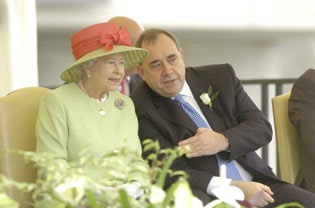 The movement for a more independent Scotland had been around for some time. Right at the start of the post-war years in 1948 there was a two million strong petition for a Scottish Parliament and although the tide washed in and out on the issue the current never quite went away.
In the October '74 General Election the Scottish National Party (SNP) who'd never won a single MP in a General Election before that year, won over 30% of the Scottish vote and 11 MPs, mainly at the expense of the Conservatives. To put that in context in 2010 the SNP won 19.9% (an increase of 2.3% on the previous time). The issue was alight again.
There was no support for Scottish independence at (Labour) cabinet level but the new SNP threat had to be scuppered somehow, so a referendum on devolution was approved, primarily as a way of heading off full scale independence.
One London Labour MP (George Cunninghame) successfully moved an amendment insisting that not only did the referendum have to pass with a simple majority at least 40% of the electorate had to vote in favour, effectively turning abstentions into no votes. A similar Parliamentary proposal was put forwards for the AV referendum last year incidentally, but it found little support.
The campaign in favour was split. SNP activists were divided between those who (understandably) saw the devolution question as a way of preventing independence and more pragmatic SNP activists who thought devolution was a step towards their goal.
Likewise, although Labour was officially in favour of the proposals they themselves had initiated high profile MPs, like Robin Cook, placed themselves firmly in the NO camp. The forces who would expect to have been in the YES lobby were horribly split among themselves culminating in two official YES campaigns (the SNP one and the one for everyone else) which enjoyed only lukewarm support at best from the hard line reformers.
Meanwhile the NO camp, with it's rather simple 'bollocks to it' message (that wasn't an official slogan mind) was united, clear in its message and, with a Labour government shuddering to a halt, a NO vote could be seen as a parting shot to the dying government from its detractors.
early polls had indicated a comfortable win for the YEs campaign but March '79 found the YES vote scrapping in by the skin of their teeth. 51.6% of those who voted, voted in favour. But George Cunninghame had his revenge because, on a 63.6% turnout, only 32.8% of the electorate had voted YEs and 30.8% had voted NO. The referendum fell on a technicality.
The referendum, having gone down to defeat, pulled the SNP down with it and later that year they went from 11 MPs to just two, so in many ways the halfway house of devolution DID put a hole in the SNP's historic rise.
Two light words of caution about drawing too strong a parallel with the AV referendum though. There are certainly parallels between the pro-independence campaigns of '79 and pro-PR people of 2011 - both are divided into 'step towards our goal' and 'attempt to head off our goal' groupings, but the fact that the devolution referendum lost does not in itself prove wrong those who said it would not lead to independence, even f you think they should have set their sights lower.
The second point is that while devolution falls short of independence it is an increase in the level of independence or autonomy of the Scottish nation while AV is not more proportional that First Past the Post (FPTP). In fact Av entrenches the concept that only those with majority support should be elected to Parliament at all - which is the opposite of the PR principle that minorities should still have a Parliamentary voice.
You can argue that demonstrating a willingness to reform, and reject FPTP, may make PR more likely (and I'd like to see that argument made rather than simply stated as a fact) you can argue that AV is preferable to FPTP - but what you cannot credibly do is argue that AV is more like PR than FPTP in the way that devolution certainly is more like independence than no devolution.
These caveats aside I think the '79 devolution referendum is instructive in a number of ways. It shows how a question posed deliberately in favour of a reform few were advocating is divisive among reformers. It shows how a divided campaign can lose ground to a united opposition and how, once a referendum is put, no matter what way the answer falls you've had your option for change for a generation.
From the archives: The Anti-Capitalist Hustle
The following is one of my reports from July 2005 from Edinburgh during the G8 GlenEagles protests. The rather fun film Kung Foo Hustle was showing in cinemas at the time (just to explain the title's context). The Scottish Socialist Voice front page summed it up when it said "They came in intimidating dark colours with accents that marked them out as outsiders, armed and intent on violence. The Metropolitan Police, the West Yorkshire Police, the Humberside Police." The press has been whipping up the fears of the Scottish people for over a fortnight now and, as the way it goes now, the media first makes people afraid and then interviews them about their fear.
If they were to be believed, scenes of anti-capitalist protests would be more like scenes from the film Kung Fu Hustle. Also, those naughty, naughty embedded journalists from the BBC had been telling the world that the protests had been cancelled. Tut, tut, that's not very neutral - or factual. It's interesting, if not surprising, that the BBC was happy to broadcast news that there was no evidence for, simply in order to try to do the G8 a favour and turn protesters back from the demonstrations.
Today has been a day when the anti-capitalist movement has fought a good battle on many fronts and the disruption that they've caused to the G8 summit is not one tiny fraction of the disruption and devastation that the policies of the G8 countries create. The day began with anarchists, in true Che Guevara style, taking to the hills in order to rain chaos down upon the forces of their law and order.
Early morning road blockades and skirmishes with riot police resulted in a real headache for them and only a handful of activists arrested. One set of such activists at the Dissent rural convergence centre in Stirling were confronted by police the moment they attempted to leave their encampment. But they were still able to block a key road, preventing bowler-hatted apparatchiks getting to the summit on time. Other black-clad activists were able to disrupt Dunblane train station preventing other G8 summit goers getting to their appointments. By this time G8 Alternatives had organised numerous coaches from all over Scotland and were attempting to converge on the pretty village of Auchterarder. The police had been practising their tactics of disrupting transport yesterday at the Dungavel protest and they did their best to prevent activists even attending the demonstrations. This made a mockery of police assurances that they would comply with the Scottish Parliament decision to allow the protests to take place.
Many coaches were detained outside of Stirling at the Broxden roundabout. Protesters became more and more frustrated but as their numbers built up the police found it far more difficult to contain their potential anger. They were given an ultimatum: let us protest at Gleneagles or we protest here, cutting off western road links for the whole of Scotland.
The police had tried various tactics to explain why they thought it necessary to detain the coaches, claiming that the anarchists had blocked off the road leading into Gleneagles. This was completely untrue and a blatant attempt by the boys in blue to create divisions within our ranks. At last the coaches were allowed to set off but only with a police escort chugging along at ten miles an hour.
Meanwhile in Edinburgh, thousands of protesters had been prevented from even getting on their coaches and in frustration a vigorous blockade of Princes Street took place with 2000 angry anti-capitalists. The police moved in and arrested the stewards because there's nothing they hate more than an orderly demonstration. At Auchterarder, the several thousand protesters who had managed to make their way through earlier in the day, despite the police preventing anyone getting off at the train station, were soon joined by the really impressive convoy of coaches released from the police blockade. There must have been around fifty coaches, including double-deckers, parading through the village. The villagers' response was heart-warming to say the least. Smiling, waving, with thumbs up, time and again the villagers showed they had not bought into the bullshit.
Thousands of protesters then assembled and marched down towards Gleneagles. One of the protest organisers, Chris Nineham of Globalise Resistance, estimated that there were 10,000 protesters at the scene and we marched down to the steel fences that surrounded the conference centre. Some protesters took themselves into a nearby field as they were watched by rows of well-armed mounted police.
The scene was that of a well fortified encampment with lines of police and watchtowers with searchlights and Chinook helicopters circling overhead. The protesters rattled the fences and some, though not many, breached the outer defenses, if only momentarily. Police then set dogs loose into the fields and the mounted police beat some demonstrators back with brutal force. Police at the back of the demonstration, unbeknownst to the rest of us, harassed and intimidated and in some cases detained protesters. Whilst we were not able to get any further, we were within spitting distance of the world leaders.
What do these demonstrations prove? That the movement's very diversity is our strength. Whether we're black-clad, red-clad or white-clad, we all have a positive contribution to make. But it also shows that, in a sane society, the rings of police surrounding the conference centre would not have been facing outwards, opposing the demonstrators for peace and social justice, but would have been facing inwards, smashing up the meeting of those responsible for the impoverishment and murder of countless thousands of people around the globe.
 Annie Leonard and co. (
 Adrienne Mayor (
 Ed Howker and Shiv Malik
 Floella Benjamin (
 Mark Watson (
 Tim Jackson (
 David Wilson (
 Clive Lord (
 Nickie Roberts
